
In “Unlearning
the Myths That Bind Us” (from Rethinking
Our Classrooms) Linda Christensen discusses the ways in which children’s
stories, be they in the form of cartoons; fairy-tales; or films; work to, somewhat
insidiously, pass on society’s dominant ideologies. She also describes the way
in which her classes have dealt with the idea of children’s stories as a way to
teach children how to behave in-line with societal expectations. There was
nothing surprising in this reading for me, as I’ve been pretty aware of the
ways in which our media, whether directed at adults or children, works to try
and create conformists of us all. However, it was refreshing to read the ways
in which Christensen’s students attempted to take direct action against this “secret
education” (126).
One of
Christensen’s students noted that “when we read children’s books, we aren’t
just reading cute little stories; we are discovering the tools with which a
young society is manipulated” (126). Omar hits the nail right on the head;
taking a critical eye to stories and media aimed at children can prove to be
very enlightening (and disheartening). Take, for example, one of the morals
that Perrault offers for the classic fairy tale Little Red Ridinghood (the story, as well as the entire Norton
collection of The Classic Fairy Tales
can be found here):
From this story one learns that children,
Especially young
girls,
pretty, well-bred,
and genteel,
Are wrong to
listen to just anyone,
And it’s not at
all strange,
If a wolf ends up
eating them.
I say a wolf, but
not all wolves
Are exactly the
same.
Some are perfectly
charming,
Not Loud, brutal,
or angry,
But tame,
pleasant, and gentle,
Following young
ladies,
Right into their
homes, into their chambers,
But watch out if
you haven’t learned that tame wolves
Are the most
dangerous of all.
 Perrault’s version of Little Red Riding is an incredibly
common, and still told, version of the fairy-tale. This moral, a moral told
to young children at the tail-end of a story meant to soothe them to sleep, not
only perpetuates the idea that women must constantly be ever vigilant of men
lest they get ‘eaten’ (also known as raped. Or, perhaps, even simply sexed
before marriage) but it also highlights one of the (many) ways in which patriarchy is
harmful to men as well as women. It
depicts all men as being beholden to their carnal nature; it makes it sound
like men are unable to control themselves and that they are inherently animalistic
so all women just need to beware. This is a harmful idea to disperse not only
because it feeds directly into our modern rape culture but also because it’s an
incredibly insulting (and untrue) portrayal of men. It makes it seem as if all
men are potential rapists (wolves) because they just cannot help themselves. Now Little
Red doesn't seem all that much like a “cute little story” does it? And it didn't even take the most critical eye to see the problem with this moral, it just
took a mind open to questioning things that we've been taught to be comfortable
with.
Christensen
spends some time addressing stereotypes, their prevalence in children’s
stories, and the ways in which they are harmful. She states that “the
stereotypes and worldview embedded in the stories become accepted knowledge”
(127). This idea, coupled with her earlier quote from Beverly Tatum (“cartoon
images…were cited by the children…as their number one source of information”)
is particularly troubling when we take a look at many of the cartoons that our
society’s children are watching. There’s no getting away from the racism and sexism that is
prevalent in children’s media. Jafar, from Aladdin,
a somewhat recent Disney film, is portrayed as far darker and more “ethnic”
looking than the ‘good’ characters from the film. Whether or not that is a
coincidence (which is doubtful), the message it sends is that ethnic=bad (as
well as ugly and old=bad, which we also get from Ursula in The Little Mermaid, the crone from Snow White, the list could go on).
 The stereotypes
don’t stop once the images are no longer being targeted at children. Media is
constantly pushing the dominant ideology on its consumers, whether the consumer
is 3 or 33. This serves to ensure that the values that have been subliminally
taken in stick with us. We have to be constantly bombarded with these
problematic images otherwise we are more likely to hit that pane of glass in
the river (for those that missed class on Thursday this reference may be indiscernible, shoot me
a message and I’ll clarify for you!). Let’s
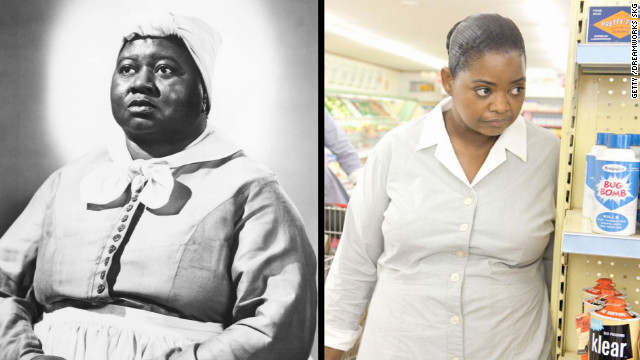
use the past Black female Academy Award winners for example. All of these women
were in films for adults. And they all portrayed common stereotypes of
Black women. Halle Berry, the only Black
woman to have won an Oscar, won for Monster’s Ball in 2001 for playing Leticia
Musgrove, a character that very much fits the common Black trope of the “Jezebel”.
Five Black women have won Academy Awards for supporting roles. The first was
Hattie McDaniel for playing the quintessential Mammy (known as…Mammy) in Gone with the Wind. Whoopi Goldberg won
her Oscar for playing a Magical Nigress in Ghost.
Jennifer Hudson was the overweight Black Diva in Dreamgirls (arguably the least
offensive trope to have won an Oscar). Mo’Nique won her Oscar for her portrayal
of Mary Lee Johnston in Precious;
Mary Lee was an abusive, “welfare queen” who was a parasite not just on the
system but also her daughter. And lastly to bookend the list we have the most
recent Black Academy Award winner: Octavia Spencer for her role as
In class next week
(or perhaps in the comment section of this post) I would like to find
out what stories/shows/movies my peers once loved (or still love) that, upon
critical analysis, they see as being incredibly problematic and simply stories
that are acting as mediums for the dominant society’s message. Me first: I love Mulan, but unfortunately there is plenty of sexism and problematic racial portrayals in that film. I still will break out in song anytime someone says "Let's get down to business", but I no longer love that film unquestioningly. Furthermore, I’d
like to talk about ways in which people feel like we can take direct action and
work to counteract the messages that are being forced down our children’s
throats. Christensen’s class did some interesting work, I’d like to see how we
can further build upon what we've read in the text.
Works Cited
Christensen,
Linda. "Unlearning the Myths That Bind Us." Rethinking Our Classrooms: Teaching for
Equity and Justice / [editors ... Bill Bigelow ... Et Al.]. By Bill Bigelow, Linda Christensen, and
Stan Karp. Milwaukee, WI: Rethinking Schools, 2007. 126-37. Print.
