Sunday, February 10, 2013

A Tangle of Discourse: Girls Negotiating Adolescence--Quotes


When addressing the weaknesses of the discursive framework that Rebecca C. Raby sets forth in “A Tangle of Discourse: Girls Negotiating Adolescence” she notes that “Discourses are deployed unevenly between adolescents of differing social locations…Similarly, discursive effects are unequal. In particular, the surveillance and regulation of youth is significantly affected by gender, class, and race.”(426) This quote is taken from the beginning of the text, and it is where Raby is noting some of the problems of her own study and studies like hers as well as explaining her decisions in how she conducted her study. Raby notes these caveats so that they are made clear, but she doesn’t take them into account for her own study (which she herself recognizes in the same paragraph as the above excerpt). It is completely understandable for Raby to “set [gender, class, and race] aside in [the] paper” (426); the scope of her study could not incorporate a section on the intersections of gender, class, and race with adolescence. It is unfortunate, however, because there would surely be some enlightening results had she been able to incorporate and elaborate on such an intersection. For example, the way in which young Black/Latino boys are perceived compared to young White males would be quite interesting, particularly when discussing the carceral nature of the surveillance as it applies to these young men.

In her section “Discourses of Adolescence” Raby shares the definition of discourse that she is working with. Raby elaborates upon the concept of discourse that Vivian Burr defines in An Introduction to Social Construction:
Discourses organize how we think, what we know and how we can speak about the world around us. Vivian Burr notes ‘A discourse refers to a set of meanings, metaphors, representations, images, stories, statements and so on that in some way together produce a particular version of events’…Privileging one set of representations over another, discourses tend to claim the status of truth. We are always embedded in discourses. As such, and as discourses work as truth statements, it is difficult to ‘see through’ them to identify how our reality is shaped. (430)

It is important that the reader understands the way in which Raby is using “discourse” because the entire study is built upon the idea of discursive frameworks about adolescents/ce and the way in which adolescents interact with the framework. The definition should seem really familiar to us by now, as it could also be applied to “ideologies”. I posit that the dominant ideologies of society work to create the dominant discourses. We see this in Raby’s own study. For example: Capitalism is an obvious dominant ideology in our society; unsurprisingly, “pleasure consumption” is a dominant discourse of adolescence that Raby identifies. Our consumer culture has been able to manipulate teenagers in a variety of ways. Raby notes that “self-expression and identifications are intricately expressed through certain types of fashion…and body adornment” (437). This is a wonderful example of how the various discourses interact with one another. Rebellion and finding oneself as an individual has become naturalized (these are the discourses Raby labels as “the storm” and “becoming”) to a point these things seem inherent to adolescence. Consumer culture markets specifically towards teenagers, telling them that they can find themselves at the local mall. Telling them that makeup, or certain fashions, will help them make a statement to the world. In order to fulfill the “need” to rebel/express oneself many teens fall prey to the manipulation of consumer culture. This is the pleasurable consumption. It is pleasurable because it fulfills what is perceived as an innate desire.

                Perhaps the most interesting part of Raby’s study, which unfortunately she did not spend much time on, was the ways in which the teens she studied not only accepted but actively engaged with  the dominant idea of what a “teenager” is. Raby noted that “the teens that I interviewed had such difficulty negotiating their occupation and rejection of the category ‘teenager’…All of them easily cited negative stereotypes about teens…Often the young women would cite several negative stereotypes about teenagers, then distance themselves and their friends, often through the separation of ‘good’ teens from the ‘bad’ ones” (441). I find this particularly interesting because this seems to be a common practice in many subjugated groups (as Raby calls teens. Whether or not they can truly be considered a subjugated group is up for debate). It isn’t uncommon to have conflicted People of Color distance themselves from other POC, noting that they aren’t like “those other ____ folk” or people from lower classes using others as an example of what they are not/will never be (see half of the conversation surrounding Honey Boo Boo) These teenagers are both accepting and rejecting the dominant idea of what a “teenager” is. They view themselves as exceptions to the stereotype instead of really reflecting on the fact that perhaps the stereotypes themselves are flawed. I will use a PSA I found on Youtube to close this post. 

It was made by a youth coalition, which is important to note. Because it was made by a youth coalition it seems like it would not be a ridiculous to assume that the teens had a lot of input on the direction of the video. Now, with that in mind, take a close look at the teen who wants beer. She is at once othered by her piercings and desire to drink beer and yet also very much “in line” because of those desires. The other teenagers are exceptions to the dominant stereotypes, look how clean cut they are! And they love root-beer ‘cause beer is totally uncool. It is interesting that these youth chose to make the “bad apple” a girl with obvious physical forms of “self-expression” and “rebellion” (the piercings). It’s clear that in this moment the youth coalition bought into the dominant discourses of what a rebellious teenager is/looks like/desires. 

Questions and Comments:
During the week I would like to discuss ways in which our mainstream media, particularly television shows and films aimed at teenagers, works to naturalize the discourses that Raby identifies. We should keep in mind that many of these shows 'about teen lives' are created by adults. Keeping that in mind will certainly lead to interesting analyses of popular representations of teenagers in media today.

Works Cited

Header image found here
Discourse image found here

Raby, Rebecca C. "A Tangle of Discourses: Girls Negotiating Adolescence." Journal of Youth Studies 5.4 (2002): 425-48. Web.

Thursday, February 7, 2013

Faces of Addiction

I stumbled upon an amazing photostream today, it's called Faces of Addiction. Really powerful images. Here's the photographer's description of the album:

‎"The stories of addicts in the Hunts Point neighborhood, the poorest in all of New York City. I post people's stories as they tell them to me. What I am hoping to do, by allowing my subjects to share their dreams and burdens with the viewer and by photographing them with respect, is to show that everyone, regardless of their station in life, is as valid as anyone else. Its easy to ignore others. By not looking, by not talking to them, we can fall into constructing our own narrative that affirms our limited world view. "

Great piece, if you haven't checked it out yet please do so. And explore his other photostreams.

Tuesday, February 5, 2013

Birthing While Black from My Brown Baby

Just saw this article making the rounds on tumblr and it made me think about the reading and some of the blog responses people have put up. This woman's account, and the many Black women she represents, certainly sheds a light on why it's so difficult for Black women and girls to see themselves as princesses. Even when they have the money for "royal treatment" they are often still treated like garbage. This is why I'm not 100% against some race-bending fairy tales. I want more Black princess stories out there because society often treats Black women like they can amount to nothing more than maids/servers (unless of course they are the lucky few to be RICH and FAMOUS. But, that's a whole different conversation that would involve a lot about pigmentocracy and White standards of beauty because...well take a gander at the richest and most famous Black women, many of them very much fall in line with the general aesthetic that is accepted by the mainstream).

From the article
Despite an incredible birthing experience facilitated by my personal angel/ob-gyn, from almost the moment my baby took her first breath, her mother was treated like a 14-year-old drug-addicted welfare queen, there to push out yet another daddy-less baby. Seriously.
  • They tested my newborn for drugs (though I’ve never taken an illicit substance in my entire life) without my consent—something I later found out hospitals do at disproportionately higher rates with black babies than white ones.
  • Despite that I paid for the private room and meals, I was immediately put in a massive post-birth room with three other women and their newborns. I was moved only after I asked why I wasn’t in a private room—a question that elicited scowls and foot-dragging from the nurse until she bothered to check my paperwork to see that, indeed, I’d paid for a private room. It took three hours for my room to be changed.
  • Once in the private room, the nurses disappeared for nine hours! Seriously.Nine.I had no diapers. No idea how to breastfeed properly (and no bottle or milk to feed my baby if I chose to formula feed). No instructions on what to do to care for my post-birth body (was it okay to walk? Pee? Wash?). Nothing. I seriously thought I was being punished for asking (nicely) for what I’d paid for. When a nurse finally did show up, she came with a “gift bag” full of Similac and coupons for… Similac.
  • The private “suite” was disgusting. The bathroom smelled like cheap, potent cleaning chemicals. The shower tiles were grimy and the shower curtain was full of mold. There wasn’t so much as a picture on the bland walls. (I begged my back-up ob-gyn to let me go home after one night; thank God, she signed off on it.)
  • The nursing staff was genuinely surprised (!) that the guy by my side, Nick, was my husband—and actually said that stupid ish out loud.
  • Our special meal arrived only after we pointed out to the nurses that the fees we paid included it, and by the time it got to us, our dinner was cold and our champagne (a tiny hand-held bottle we could have finished with one big sip from the straw) was warm.
I couldn’t get out of that place fast enough. And when it came time for me to have my second child, I stayed far, far away from that hospital—even changed my ob-gyn, which really broke my heart to do—to avoid it like the damn plague.
I wondered then what I know to be true now: It didn’t matter how much money I had in my bank account or how good my insurance was, or that I had a ring on my finger, or that I was smart and accomplished, or that I tried to pay my way out of substandard service. At the end of the day, to almost everyone in that hospital, I was just another black girl pushing out another black baby and neither of us deserved to be treated with dignity or respect, much less special. That human beings charged with caring for new life and the people who ushered in that miracle could traffic in this kind of reprehensible treatment of anyone, much less a new mother—no matter her race, financial or marital status, or background—is beyond my level of comprehension.

Saturday, February 2, 2013

Unlearning the Myths That Bind Us-Reflection


                In “Unlearning the Myths That Bind Us” (from Rethinking Our Classrooms) Linda Christensen discusses the ways in which children’s stories, be they in the form of cartoons; fairy-tales; or films; work to, somewhat insidiously, pass on society’s dominant ideologies. She also describes the way in which her classes have dealt with the idea of children’s stories as a way to teach children how to behave in-line with societal expectations. There was nothing surprising in this reading for me, as I’ve been pretty aware of the ways in which our media, whether directed at adults or children, works to try and create conformists of us all. However, it was refreshing to read the ways in which Christensen’s students attempted to take direct action against this “secret education” (126).

                One of Christensen’s students noted that “when we read children’s books, we aren’t just reading cute little stories; we are discovering the tools with which a young society is manipulated” (126). Omar hits the nail right on the head; taking a critical eye to stories and media aimed at children can prove to be very enlightening (and disheartening). Take, for example, one of the morals that Perrault offers for the classic fairy tale Little Red Ridinghood (the story, as well as the entire Norton collection of The Classic Fairy Tales can be found here):
                                From this story one learns that children,
Especially young girls,
pretty, well-bred, and genteel,
Are wrong to listen to just anyone,
And it’s not at all strange,
If a wolf ends up eating them.
I say a wolf, but not all wolves
Are exactly the same.
Some are perfectly charming,
Not Loud, brutal, or angry,
But tame, pleasant, and gentle,
Following young ladies,
Right into their homes, into their chambers,
But watch out if you haven’t learned that tame wolves
Are the most dangerous of all.

Perrault’s version of Little Red Riding is an incredibly common, and still told, version of the fairy-tale. This moral, a moral told to young children at the tail-end of a story meant to soothe them to sleep, not only perpetuates the idea that women must constantly be ever vigilant of men lest they get ‘eaten’ (also known as raped. Or, perhaps, even simply sexed before marriage) but it also highlights one of the (many) ways in which patriarchy is harmful to men as well as women. It depicts all men as being beholden to their carnal nature; it makes it sound like men are unable to control themselves and that they are inherently animalistic so all women just need to beware. This is a harmful idea to disperse not only because it feeds directly into our modern rape culture but also because it’s an incredibly insulting (and untrue) portrayal of men. It makes it seem as if all men are potential rapists (wolves) because they just cannot help themselves.  Now Little Red doesn't seem all that much like a “cute little story” does it? And it didn't even take the most critical eye to see the problem with this moral, it just took a mind open to questioning things that we've been taught to be comfortable with.

                Christensen spends some time addressing stereotypes, their prevalence in children’s stories, and the ways in which they are harmful. She states that “the stereotypes and worldview embedded in the stories become accepted knowledge” (127). This idea, coupled with her earlier quote from Beverly Tatum (“cartoon images…were cited by the children…as their number one source of information”) is particularly troubling when we take a look at many of the cartoons that our society’s children are watching. There’s no getting away from the racism and sexism that is prevalent in children’s media. Jafar, from Aladdin, a somewhat recent Disney film, is portrayed as far darker and more “ethnic” looking than the ‘good’ characters from the film. Whether or not that is a coincidence (which is doubtful), the message it sends is that ethnic=bad (as well as ugly and old=bad, which we also get from Ursula in The Little Mermaid, the crone from Snow White, the list could go on). 

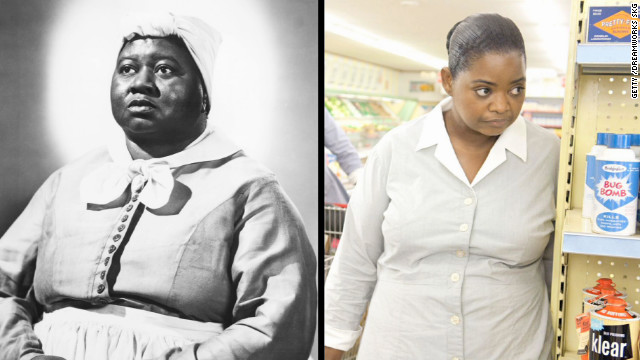
                The stereotypes don’t stop once the images are no longer being targeted at children. Media is constantly pushing the dominant ideology on its consumers, whether the consumer is 3 or 33. This serves to ensure that the values that have been subliminally taken in stick with us. We have to be constantly bombarded with these problematic images otherwise we are more likely to hit that pane of glass in the river (for those that missed class on Thursday  this reference may be indiscernible, shoot me a message and I’ll clarify for you!).  Let’s use the past Black female Academy Award winners for example. All of these women were in films for adults. And they all portrayed common stereotypes of Black women.  Halle Berry, the only Black woman to have won an Oscar, won for Monster’s Ball in 2001 for playing Leticia Musgrove, a character that very much fits the common Black trope of the “Jezebel”. Five Black women have won Academy Awards for supporting roles. The first was Hattie McDaniel for playing the quintessential Mammy (known as…Mammy) in Gone with the Wind. Whoopi Goldberg won her Oscar for playing a Magical Nigress in Ghost. Jennifer Hudson was the overweight Black Diva in Dreamgirls (arguably the least offensive trope to have won an Oscar). Mo’Nique won her Oscar for her portrayal of Mary Lee Johnston in Precious; Mary Lee was an abusive, “welfare queen” who was a parasite not just on the system but also her daughter. And lastly to bookend the list we have the most recent Black Academy Award winner: Octavia Spencer for her role as Mammy Minny Jackson in The Help. All of these films are for adults. All of these films continue the “secret education” that we received as youths. The secret education starts early and it never stops, this is why we must be always be critical consumers. 

               In class next week  (or perhaps in the comment section of this post) I would like to find out what stories/shows/movies my peers once loved (or still love) that, upon critical analysis, they see as being incredibly problematic and simply stories that are acting as mediums for the dominant society’s message. Me first: I love Mulan, but unfortunately there is plenty of sexism and problematic racial portrayals in that film. I still will break out in song anytime someone says "Let's get down to business", but I no longer love that film unquestioningly. Furthermore, I’d like to talk about ways in which people feel like we can take direct action and work to counteract the messages that are being forced down our children’s throats. Christensen’s class did some interesting work, I’d like to see how we can further build upon what we've read in the text. 


Works Cited

Christensen, Linda. "Unlearning the Myths That Bind Us." Rethinking Our Classrooms: Teaching for
Equity and Justice / [editors ... Bill Bigelow ... Et Al.]. By Bill Bigelow, Linda Christensen, and Stan Karp. Milwaukee, WI: Rethinking Schools, 2007. 126-37. Print.

McDaniel/Spencer Image found on CNN

Thursday, January 31, 2013

Libertalia's "Women vs Today and the Everyday: February Friday Film Series"

Saw this film series and am really excited for it, figured I'd share with y'all.

From Libertalia's Facebook event:


A film series that looks at the struggles that contemporary women face, struggles that are often ignored, dismissed or accepted. Do the different forms of feminism and women's movements of the past help us deal with today's conditions, or can we find new ways to address and oppose new forms of both visible and invisible oppression?


Feb. 1 – Letters from the Other Side (2006)

A documentary focusing on the lives of women in Mexico whose lives are destroyed by the effects of NAFTA, immigration, and the violence of globalization.

For more information: http://www.sidestreetfilms.com/


Feb. 8 – Killing Us Softly 4 (2010) / Slaying the Dragon: Reloaded (2011) / The Souls of Black Girls (2008)

These three short documentaries address various and constant forms of media control over women's bodies and self-image, from a critique of advertising to the even more toxic feedback presented to women of color.

For more information: http://www.thesociologicalcinema.com/1/post/2010/10/killing-us-softly-4-advertisings-image-of-women.html

http://www.asianwomenunited.org/slaying-the-dragon-reloaded-2011/

https://www.createspace.com/256654


Feb. 15 – The Edge of Each Other's Battles: The Vision of Audre Lorde (2002)

A documentary film created after the I AM YOUR SISTER CONFERENCE in honor of black lesbian feminist poet Audre Lorde, in which 1200 activists from 23 countries came together to celebrate and support Lorde's vision of liberation.

For more information: http://www.wmm.com/filmcatalog/pages/c621.shtml


Feb. 22 – Women Without Men (2009)

Magical realism set against the backdrop of the 1953 CIA-led coup against Iran's democratically elected Prime Minister. Banned in Iran, this film centers on the lives of four women and the real ways in which human rights, civil rights and women's rights are often more mythical than fiction.

For more information: http://womenwithoutmen.blog.indiepixfilms.com/


"I am not free while any woman is unfree, even when her shackles are very different from my own." - Audre Lorde


Fridays in February at 7 pm.

The films will be followed by snacks, coffee, tea and discussion.

Suggested donation $3-5, but no one will be turned away.

Tuesday, January 29, 2013

February Schedule for Providence Africana Reading Collective

If anyone is interested in coming then...well just pick a date (or all of the dates!) and show up. Or you can message me (asterling_6156@email.ric.edu or parc.andrea@gmail.com) and ask questions or whatever. I'm generally able to give rides if people need them, provided you live in Providence.

Whether you can come or not here is the reading in case you are interested. Amilcar Cabral is a revolutionary figure who deserves far more respect and attention than he is given in most schools/classrooms.

Sunday, January 27, 2013

Media and Ideology: Reflection


            Croteau’s “Media and Ideology” was such a fitting piece for me to read at this point in my life. The work that I do with PARC, as well as the topics that I enjoy reading about, tend to have a foundation in criticizing the ideology of the dominant society. Croteau notes that “when scholars examine media products to uncover their ‘ideology’, they are interested in the underlying images of society they provide. In this context, an ideology is basically a system of meaning that helps to define and explain the world and that makes value judgments about that world” (159). I personally believe that the ideology of the dominant society is one that is patriarchal, White supremacist, and anti-Black. This ideology is often conveyed in various forms of media, although somewhat subtle to the unquestioning eye. To have the media act as a medium for the dominant ideology, given the prominence of media in our everyday life, is an incredibly powerful way to indoctrinate people. More often than not the media that we consume isn't obviously misogynistic or racist, instead the things being presented often seem “natural” or “normal”. Croteau touches upon this wonderfully in his section ‘Ideology as Normalization’. He states:
Media texts can be seen as key sites where basic social norms are articulated. The media gives us pictures of social interaction and social institutions that, by their sheer repetition on a daily basis, can play important roles in shaping broad social definitions…the accumulation of media images suggests what is ‘normal’ (163).
When we are constantly being faced with certain behaviors we begin to see them as “natural”. When in reality what has happened is that those behaviors have become naturalized in our minds because of how regularly we see these behaviors. This can be particularly harmful when we do not have many interactions with the communities whom we are watching or reading about. This was the thinking behind much of the protest about the Oxygen reality show All My Babies Mama’s (read more about the controversy here). Black folk in television are often presented as pimps, hos, minstrels, thugs, unstable, and various incarnations of the aforementioned tropes as well as others. When not looking critically it’d be easy for people to not realize the proliferation of those tropes and to not realize the ways in which they have begun to see every-day Black folk in similar ways, even subconsciously. This is the reason why when a ‘well-spoken’ Black person speaks they often get showered with compliments of how “articulate” and “eloquent” they are. Those delivering the compliments do not realize exactly where their surprise is coming from and instead thinks they are being complimentary when in reality they are behaving in a manner that shows a subscription to the dominant view of Black folks being under-educated and inherently inarticulate. At this point I’ve only focused on the way this type of representation of Black folk affect those outside of the Black community. To try and touch upon the ways it affects Blacks, particularly Black youth, would double the length of this post. To put it simply, the ways in which Blacks are often represented in media lends a direct hand in the internalization of racist and anti-Black beliefs within the Black community itself. This, however, is not a call for all representations of the Black community in media to be "positive", but rather a call for balance. As Langston Hughes said in "The Negro Artist and the Racial Mountain" we, as Black folk, "know we are beautiful, and ugly too". Instead of representing the reality of the multifarious nature of the Black community the media tends to simply represent the image of the Black community that falls in line with society's dominant ideology. 

Another way in which we can see how the dominant society’s ideology is being dispersed through media would be to look at the treatment of Django Unchained. The film is being heralded as a great film about slave resistance when in reality it is simply a revenge film that takes place during slave times. A truly great film about slave resistance would be Haile Gerima’s Sankofa (which can be found in its entirety, although not the best quality, on Youtube). Our society has a focus on the individual, which is why a film where an individual takes out entire plantations can be beloved by all even when it does not truly represent what most resistance mobilizations look like. Sankofa, on the other hand, truly shows the collective nature of resistance and revolution. However, that theme (as well as many others), goes against the dominant ideology and therefore that film gets far less attention than the inferior Django UnChained.
The viewpoints I have expressed in this post can be seen as controversial to some but that is because they directly counter many dominant themes of our society, particularly the false notion that we are passed conversations about race because we are ‘color-blind’ or have ‘evolved’. Because of this dominant theme those who do decide to have conversations that counter the dominant ideology are accused of being purposefully controversial or playing the ‘race-card’ (which is an offensive accusation that highlights the fact that we have not yet ‘evolved’). Similar sentiments are had when people try to expose the ‘subtle’ misogyny in pop culture. Let us not fall for “common sense” and rather continue to operate with a critical eye, for if we do not look at everything critically then we may easily succumb to an ideology that seeks to repress us. This is one of the points I hope we touch upon in class: the importance of analyzing and questioning everything (see Croteau page 166).
Works Cited
Croteau, David, and William Hoynes. "Media and Ideology." Media Society: Industries, Images, and Audiences. Thousand Oaks, CA: Pine Forge, 2003. 159-68. Print.


Hughes, Langston. ""The Negro Artist and the Racial Mountain" (1926)." "The Negro Artist and the Racial Mountain" (1926). Web. 27 Jan. 2013.