Showing posts with label Talking Points. Show all posts

Monday, March 25, 2013

Talking Points 7: Brave, Orenstein--Connections

After reading Orenstein's chapters, particularly the section on "Pinkification" and then reading Tyne's blog regarding the Steubenville rape case, it only made sense that this performance came to mind. I'm glad I was able to find it as for a moment the poet's name escaped me but luckily I had posted it to tumblr a year or so ago and it was easy to find (that's why tagging is important, y'all!)
I'll post the text of it at the end of this post. Do watch the video, it's powerful

EDIT: For whatever reason the video isn't playing from here. Go watch it on youtube
Anywho, onto the post.


                Reading the Peggy Orenstein excerpts from Cinderella Ate My Daughter served not only to be a good supplement to the Pixar film Brave but also to our course assumptions, particularly the second (Youth is a Culturally Constructed Category). In the chapter “Pinked!” Orenstein gives many examples of how youth, and various stages of youth, are truly just cultural constructs and nothing more. Not only are these categories cultural constructs but they have been constructed to uphold our society’s dominant ideology of Capitalism. As Raby noted in “A Tangle of Discourses: Girls Negotiating Adolescence”, pleasurable consumption is a dominant discourse of teenagehood:
Youth today are courted as a high-consumer group, and are modelled in the
media as the ideal age, with teenagehood constituting the onset of ‘the best years
of your life’. Social historians often connect the emergence of adolescence to
processes of production and patterns of consumption (Raby, 437).
What Orenstein’s text makes clear is that teenagers aren’t the only valuable group that marketers target. The whole Princess line was created because of its marketability. Dora the Explorer, supposedly an example of Nickolodean’s subversive gender portrayals, might as well be a part of the Disney Princess line when it comes to her toys and other merchandise (Orenstein, 42). What’s actually good for the children, in this case the young girls’, psyche isn’t even a factor passed the first stage of product development. More important than teaching girls that they can be a wide variety of things, that they can embody a multitude of characteristics and interests, is cash-money. How does that not disgust everyone?

Another truly sad thing about many popular girls’ toys, particularly the Disney Princess line, is that these toys put docility and fragility on pedestal. It’s not as if these Disney Princesses are giving us subversive takes on what a princess is. They are very much in line with what we would expect. The Princesses that are showcased are always waiting for “True Love’s Kiss”, they love their man with every fiber of their being and would sacrifice themselves for said man, they often enjoy cleaning or are at least very good at it. They rarely have much motivation beyond love, and even if they started out with others motivations half way through their story LOVE becomes the biggest thing on their mind. There’s nothing wrong with love and wanting to be in a happy and fulfilling relationship, but to teach our young girls that that’s what their main focus to be is a great detriment. Even the princesses who we think combat the dominant depiction of the servile and fragile princess actually aren’t subversive at all.. In Croteau’s “Media and Ideology” he notes:
Research on the ideology of media has included a debate between those who argue that media promote the worldview of the powerful—the “dominant ideology”—and those who argue that mass media texts include more contradictory messages, both expressing the “dominant ideology” and at least partially challenging worldviews (Croteau, 161)

Where Croteau doesn’t go far enough, in this particular piece, is that he does not address how the seemingly contradictory messages are often just disguises, Trojan horses if you will. Take Mulan for example. I wrote about this before in a comment section to Julie’s second blog post on Christensen’s “Unlearning the Myths that Bind Us”. Mulan is NOT the gender-bending badass “Princess” that people like to believe she is. Nala, from Lion Kind, is more badass than Mulan to be honest. Mulan is a strong woman, yes, but the strength that she exhibits is simply a different expression of the same beliefs as the other princesses. Mulan’s great sacrifice, risking her life to fight, was in order to protect her father. It was an act of selflessness, which is a characteristic that we often teach to our young girls. Selflessness, self-sacrifice, these are traits that we instill, usually covertly, to the young women in society. In moderation these traits aren’t terrible, and in fact can serve to make someone a compassionate human being. However, girls aren’t often taught to be self-sacrificial in moderation. We are taught that we need to serve others, that we must be kind and caring and help others in any way that we can (even if that serves to hurt us). That’s a damaging thing to constantly be teaching kids, especially if no counter-message is produced.

Orenstein touched upon a wonderful point when she mentioned the ways in which intragender competition is taught to girls. There can only be one highlander princess. That princess must be the fairest in the land or else she risks her status as a princess. This competition is not only with the girls’ peers, it’s intragender-intergenerational competition that is bred. We see this through the common tropes of women presented in these stories: The Crone, The Matron, and the young beautiful girl/princess. The Crone is what we never want to be, the Crone is the old Queen who gave Snow White the apple. The Matron…well she has one foot in the doorway to Croneville. The Princess…she’s the one we want to be, she’s good/nice/sweet/beautiful/etc. This is another message that’s often given covertly (through a “secret Education” if you will). As I said, take Snow White for example. We all know what trope Snow is. The Queen, however, inhabits both. She is at once the Matron and the Crone. As she ages, she becomes more evil and more overtaken by jealousy. At the peak of her despicability she is THE CRONE. Older women are rarely depicted as anything other than evil in Princess tales (unless their ~*~*magical fairies/godmothers*~*~). We even get this in Brave, the so-called feminist Princess movie. There’s really no evil antagonist in Brave. The closest that we come to evil would be the Witch *cough*Crone*cough*. She set everything awry in Merida’s life, and if she could do that who knows what evil she’s capable of.
I did enjoy Brave, it was an entertaining film to watch. However, it was not a feminist Princess flick in the least. The majority of the competition in the film was intragender, as usual. The most subversive part of the film wasn’t that Merida was athletic and could shoot arrows like nobodies’ business but rather that she was a selfish brat. I’m not saying this because she wanted to put herself first over tradition, but the lengths that she went were incredibly selfish. Enlisting in some random witch’s help to change one’s mother is generally not a good idea. As they say in Once Upon a Time “magic always comes with a price”. And it did. Even after her mother was turned into a bear it took forever for Merida to stop thinking solely of herself and to see her mother’s plight (that she caused, mind you). And so we're still left with basically what we had before Brave. We lack a good example of a balanced character for young girls. Merida's selfishness makes me question her strength. Is she truly strong or is she just self-centered? We don't want to teach children to only be selfless, but we also don't want to teach them that they should ONLY think about themselves (unless they turn someone into a bear, then they should probably get some compassion and get their shit together).

Anywho, I don’t want to linger too long on Brave or else I won’t have anything to say in class tomorrow.

Speaking of class, I suppose my questions would be: How did y’all see Merida? Did you see her as a feminist Princess? Do you think she’s a good role model for girls? What would you envision a “feminist princess story” looking like? What would the characteristics of the Princess be? Is it possible to have a feminist princess story?


And now the text of the poem, as promised


PAPER DOLLS
Sierra DeMulder

We are taught
from the moment we leave our pink nursery
that we are collapsable paper dolls
light to hold
easier to crumple. 
that as women our worth lives secretly wrapped in lace and cotton panties
our fragility armored with pepper spray and mace, they say:
ONE IN TEN. ONE IN SIX. ONE IN THREE
women will be raped or sexually abused in their lifetime
and I am one of three daughters.

Now imagine: each victim is an acrobat
Her sanity, a balancing act
Our response is the unfailing safety net
We never expect to see her across the wire
You weren’t just violated, we tell her
You are an empty museum
A gutted monument to what used to hold so much worth
And with the best intentions we tell her to reclaim it,
Put a price tag on her rape and own it,
But don’t stand too tall, don’t act too strong
or we will name you denial, come back when you’re ready to crumble
Like your bones are made of chalk
You may only laugh cutely or cry beautifully
So cry beautifully
We will catch you

We are calling it theft 
As if he could pluck open your ribs like cello strings
Pocket your breasts, steal what makes your heart flutter and tack its wings to his wall,
Some days you will feel dirty!
Some weeks you’ll remember how hard it is to breathe in public, like your heart beat is climbing to the attic of your throat only to suicide itself out on the pavement
But know this: the person who did this to you is broken, not you.
The person who did this to you is out there, somewhere choking on the glass of his chest, 
it is a windshield, and his heartbeat is a baseball bat saying regret this, regret this

NOTHING WAS STOLEN FROM YOU.
Your body is not a hand-me-down
There is nothing that sits inside you holding your worth,
no locket that can be seen or touched, sucked from your stomach and left on the concrete
And I know it’s hard to feel perfect
when you can’t tell an Adam’s apple from a fist
because some ashtray of a man picked you to play his Eden.
but I will not
watch you
collapse.

    Sunday, February 24, 2013

    Michael Wesch-From Knowledgable to Knowledge-able---Reflection


    The quality of light by which we scrutinize our lives has direct bearing upon the product which we live, and upon the changes which we hope to bring about through those lives. It is within this light that we form those ideas by which we pursue our magic and make it realized. This is poetry as illumination, for it is through poetry that we give name to those ideas which are, until the poem, nameless and formless-about to be birthed, but already felt. That distillation of experience from which true poetry springs births thought as dream births concept, as feeling births idea, as knowledge births (precedes) understanding.

    As we learn to bear the intimacy of scrutiny, and to flourish within it, as we learn to use the products of that scrutiny for power within our living, those fears which rule our lives and form our silences begin to lose their control over us.-Audre Lorde, “Poetry is Not a Luxury”

    I’ve chosen to begin with this particular epigraph, an excerpt from Audre Lorde’sPoetry is Not a Luxury” because I feel it details, in a wondrously poetic fashion, some of the framework that I will be working from and the perspective I am critiquing the Wesch text through. Hopefully as you read this post you will more clearly understand why I’ve chosen this particular Lorde excerpt, but if anything is unclear in my choice of quotes or anything I bring up throughout this post then please feel free to ask for clarification and shoot me questions in the comment section.

    Michael Wesch
                In “From Knowledgeable to Knowledge-able: Learning in New Media Environments” Michael Wesch discusses the ways in which the predominant current teaching methods are no longer apropos given the new technological age that we are currently living in. He posits that the current teaching methods, and the classrooms themselves, are:
    built to re-enforce the top-down authoritative knowledge of the teacher…the ‘message’ of this environment is that to learn is to acquire information, that information is scarce and hard to find (that’s why you have to come to this room to get it), that you should trust authority for good information, and that good information is beyond discussion. In short, it tells students to trust authority and follow along (1).

    He goes on to note that the new digital age has given people the ability to access knowledge in a new way. In this new way of accessing knowledge they are not simply taking in information that an authority figure is spewing at them but rather they are directly engaging with the information; they are aiding in its creation, its delivery, and everything in between. He argues that knowledge, as it stands now, is not something that can simply be fed to an individual, it is something that must constantly be interacted with and in order to keep up with the way that the digital age has allowed students to engage with information classrooms and teachers must change up their stale authoritarian routine and find ways to “move [their students] from being simply knowledgeable to being knowledge-able” (1). This means that they need to learn how to truly engage with the material, they must be able to critically look at texts and analyze them, not simply memorize ‘important’ facts and reiterate said facts when an exam comes along.
                Now, just because I am able to summarize his general argument (at least in the way that I read the text) does not mean that I completely agree with the points that he uses. There were a few moments when I had to disagree with his statements, and other moments where I felt he was simply not delving deep enough.
                Given that Wesch chooses to use the language of revolution, it is disappointing that he doesn’t really deliver a deeper analysis of some of the systems that he rails against and for. One of the dominant discourses of society is that of Individualism. As the State has gotten more powerful it has worked to eradicate a sense of community and collectivism amongst people (this is clearly an attempt to stifle resistance, for no resistance can occur if people cannot develop a collective consciousness). This idea of individualism and submissiveness (to the State and those who represent the state i.e: Authority) is taught to us in many ways and settings, and one of those settings is within the classroom. Wesch notes that the current teaching methods often rely on the educator being seen as the authority figure and that all of the students must follow the instructions of said authority figure very closely. Lecture style classrooms do not breed community, they breed submission and regurgitated thinking (regurgitated thinking: we spit back out the same thought/ideas/lessons that we take in. The delivery will more than likely be in a different order from the original thought digested but the content will be exactly the same). Wesch states that the “Web 2.0” breeds a “spirit of interactivity, participation, and collaboration” (1) and that new model classrooms and teaching styles should invoke the same spirit. Doing so fosters community; it fosters connections between students with their peers and their professor. It allows knowledge and information to seem more dynamic instead of static and stagnant. The current teaching methods simply reenact the same dominator/dominated; authority/submissive narrative. In order to have a social resistance, whether it is within the classroom or beyond it, we need to advance beyond the current methods into something that creates a new, more revolutionary, narrative.
                Throughout the reading I took issue with Wesch's assertion that within new media we are able to be “creators” of information, he states this first when he talks about bloggers crating information (2). I have to strongly disagree with that. We, as bloggers or writers, are not creating information. We are vessels for information. Blogging has simply given us a new way to share said information that we have within ourselves with others. Yes, perhaps we are providing this information in a new way, but I would be hesitant to say we are “creating” it. We are simply furthering the path of information. What we are creating…what we are producing…is thought. Thought based on the information that we have collected, but we are not creating information itself. We are compiling the information and turning it into something. On a similar note, I did not appreciate Wesch’s argument that “our old assumption that information is hard to find, is trumped by the realization that if we set up our hyper-network effectively, information can find us” (2). He then goes on to use an example of a web app that I have never heard of, which feeds into my opinion that his argument comes from a place of privilege. I could make the argument that within academia there is SO much information, it seems limitless and like it is constantly coming at me. However, to say that statement and that statement alone would be ignoring the fact that academic information is hard to find for some people. Web information, even with the ubiquity if the internet, can be hard to find. Some people do not know what to look for, where to explore, or what to explore. The question becomes: How do we share our knowledge with a wider audience? Simply putting it online is not enough. How do we cultivate the appropriate audience? What even is the appropriate audience? If we limit it to fellow academics like ourselves then are we simply moving the traditional classroom onto the internet? And if we choose to broaden our audience base how do we ensure that we get as many people as we can, and how do we guarantee that we are actively engaging with them?
                A bit later Wesch discusses the idea of the “crisis of significance”. He states that we need to “bring relevance back to education” (2). I would argue that we would first have to define what education is. And this is not only the job of the educator but also the job of the person being ‘educated’. Why do they want to be ‘educated’? What do they see ‘education’ as? What is the goal of their ‘education’? For me, education for liberation is my goal. Therefore, the types of knowledge that catch my attention are most of the things that I can find applicable to resistance, resistance mobilizations/theory, forms of resistance, and foundational to revolutionary action. This framework makes many concepts quite significant, even if it doesn't seem so at first. To use this class as an example, learning about media as a medium for ideology is critical for me, as I must be able to see all of the ways that the ruling/dominant class works to manipulate and further repress others. If I cannot see how they are working against us, how could I possible begin to address ways in which to dismantle the system/structure? I think that it is our duties as students, as active engagers with knowledge, to question what our guiding framework is and what our goal is. Are you simply learning in order to eventually get a career? If so, why is that? What has taught you that in order to be ‘complete’ you need to learn things that may mean nothing to you in order to be in a job that also may mean nothing to you in order to earn a paycheck? There’s not necessarily anything wrong with that, what’s wrong (or perhaps "problematic" would be a better word) is following a narrative that has been written for you without ever stopping to question what the narrative is and why you feel the need to follow it. We must all develop a working framework for how we seek and ingest knowledge/information.
                Because this post is plenty long enough I will attempt to wrap it up by addressing Wesch’s “Not Subjects but Subjectivities” section while incorporating another quote from the magnificent Audre Lorde. This is, perhaps, the section that I had the least complaints about (other than my overarching complaint that Wesch does not delve as deeply into some of these concepts as he could/should). Wesch states that “learning a new subjectivity [ways of approaching, understanding, and interacting with the world] is often painful…You have to unlearn perspectives that may have become central to your sense of self” (3). How could I note read this as “DECOLONIZE/LIBERATE YOUR MIND!”?? Our knowledge, our current subjectivity, is not our own. It is the dominant society’s knowledge/subjectivity. We are often taught frameworks that do not allow us to further analyze our surroundings, at least not in ways that would allow us to truly QUESTION, TRANSFORM, and RESIST. At the end of her poem But What Can You Teach My Daughter Lorde states that “even my daughter…knows/what you know/can hurt/but what you do/not know/can kill”. We need to teach that! This should be our working framework! If this were our framework then would we not all be interested in gathering as much knowledge as possible and engaging with it as much as we can? If we acknowledged the fact that the knowledge that we allow to slip through our fingers could prove fatal (be it literally or metaphorically in the sense of social or civic death), then we would try our hardest to take in as much as we could, and not only that, but we would try to understand it and work with it to the best of our abilities? And with the more knowledge that we take in, the more that we develop our working frameworks for life/knowledge-gathering, the more successful we will be at dismantling the system that works to oppress/repress/suppress us!

    To try and put my questions and comments into one section would be impossible! My questions for the class are strewn throughout this post. I suppose my biggest question(s) for the class would be: what is your guiding framework for knowledge-intake? What is your goal when it comes to education? How often do you question the goals that you have that seem to be natural to you?

    And, because I love this poem so darn much, I will end this post with it.

    But What Can You Teach My Daughter
    What do you mean
    no no no no
    you don’t have the right
    to know
    how often
    have we built each other
    as shelters
    against the cold
    and even my daughter knows
    what you know
    can hurt you
    she says her nos
    and it hurts
    she says
    when she talks of liberation
    she means freedom
    from that pain
    she knows
    what you know
    can hurt
    but what you do
    not know
    can kill.

    Works Cited

    Lorde, Audre. The Collected Poems of Audre Lorde. New York: Norton, 1997. Print.
    Lorde, Audre. "Poetry Is Not a Luxury." Power, Oppression and the Politics of Culture: A Lesbian/Feminist Perspective. Web. 24 Feb. 2013.
    Wesch, Michael. "From Knowledgable to Knowledge-able: Learning in New Media Environments." Academic Commons. Web. 24 Feb. 2013.

    First image found here
    Second image found here
    Third image found here

    Saturday, February 23, 2013

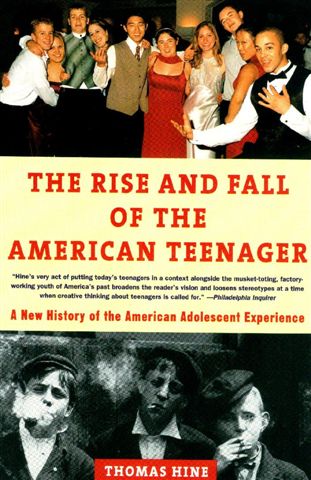
    Thomas Hines-The Rise and Fall of the American Teenager: Quotes/Reflection


    Because I have merged the format of Quotes and Reflection I have chosen to work with only two quotes so that I may explore them more in depth while still maintaining a reasonable word count.

    ’Maybe I’m something special, and maybe I’m not. Maybe I’m here for a reason and I might be going somewhere after this, but then again I might not. I wonder where I fit in?”…Figuring out where they fit in—to the universe, the world, the economy, their social circle, their family, is a project on which teenagers spend a lot of their time and energy…study after study suggests that teenagers’ principal preoccupation is to adapt, to find a place in life. (2)


    Thomas Hines, in his introduction to The Rise and Fall of the American Teenager, quotes his younger, seemingly angstier, self as a way to personally connect with the studies that he alludes to (these studies that talk about how teenagers are constantly on a quest to “find themselves”). He does so not to prove that these students are right but rather to highlight ways in which our teenage self isn’t a completely different entity from our grown-up self. This is the same idea that we address with our third course assumption: Teenagers are not some alien life form.
    On a personal level, the thoughts that Hines quotes from his younger self are thoughts that are constantly running through my mind. I am always wondering what the goal of my existence is, if I will become “something” if I will “be somebody”. The fact that these thoughts are constantly running through my head does not expose me to be stunted but rather it shows that I am human. I am a human who has grown up in this Western society. Let’s take a look at some of the “greatest” writers (I put “greatest” in quotes because there is always a question of how and why some authors are canonized and others are not, but that is not a relevant train of thought for this post) and philosophers: are not most, if not all, of them in some sort of perpetual existential crisis? Are these thoughts that Hines quotes not the thoughts that run/ran through their head constantly and served as major themes for their work? And yet somehow we have decided that it is only teenagers who are on a quest to find themselves when, in reality, we are all on the same quest. We live in an individualistic society, which not only means that we lack a sense of community with each other; it also means that we see ourselves as individual, independent, beings with personality and thoughts that mean something. Given that we identify ourselves as individuals first and community members second (or never) we, of course, are then always trying to figure out just who exactly we are. This is not a teenager crisis, it’s a human crisis.

    This lengthy waiting period has tended to reduce young people’s contacts with older people and increase them with people who are exactly the same age. That, in turn, has led to the rise of a youth subculture that has helped define and elaborate what it means to be a teenager (7).
    The lengthy waiting period Hines is talking about is the “long period of education, exploration, and deferred responsibility” (7). Teenagers are in school longer than their predecessors (or, rather, their predecessors’ predecessors); they are less likely to be expected to work, and generally when they do work they are employed at places that aim to hire teenagers; and they are expected to be on the aforementioned existential journey to find themselves. All of these factors lead to less cross-over with non-teenagers and so teens are often surrounded by their peers, resulting in "youth subculture".
                    Now, just because I can summarize Hines’ argument does not mean I agree with it fully. This point of his is perhaps the point that makes it the most obvious that his usage of teenager actually means middle-class White teenager. Depending on one’s social class and situation it should not be expected that they 1) will not be working and 2) will have less interaction with those older than themselves. This does not take in account the families who live in a household with multiple generations (and thus are not only spending time with people a bit older than themselves but with those who are FAR greater in age). A teenager who has to help support the family does not have the luxury to only choose a job that allows them to essentially shoot the breeze with other teens. They will be on the hunt for a job that best suits their needs and their schedules, regardless of the age and life circumstance of their co-workers. And having to be a pillar of support for the household tends to mean lots of work hours, and if this teen is a good student then they certainly do not have all that much time to spend hanging out with other teens. Free time is a luxury for many teenagers. I’m not saying that what Hines posits is wrong but rather that it just does not take enough different factors into account. He should have made a disclaimer or made a less generalizing claim, but because he did I feel that it is our duty to take him to task for that (even if it is simply on our blogs and in class). In general, in class I would like to further discuss the ways in which Hines makes it clear that the “teens” he talks are about are middle class White teens. Middle class White teenagers is a shrinking group, there is no reason why texts should still use them as a norm, and no reason why we should accept that norm willingly.

                    On a personal level, I have to wonder if some of these things are why I often feel a bit of a disconnect with my peers. I’ve been working since I was 13 and had 3 jobs at the age of 15. Due to various personal life circumstances I did not have the “typical” (again, what is “typical”, really?) teenage experience. This idea of the “teen subculture” is so prevalent that those who existed outside of said subculture are at a bit of a loss with their peers. That doesn’t make those of us who had different teenage experiences any less of a “teenager”, it simply means we didn’t have the expected teenage life. And in these changing times, how many people are actually having the expected teenage experience? What is the “teenage subculture” truly? Can we simply give it such a general name when the subculture may vary by race, region, etc? And, by implying that there is a shared “teenage experience” aren’t we furthering the feelings of confusion, angst, un-belonging, for those teenagers who exist outside of said experience?

     Works Cited
    Hine, Thomas. The Rise and Fall of the American Teenager. New York: Bard, 1999. Print.

    First Image found here
    Second Image found here
    Third Image found here

    Sunday, February 10, 2013

    A Tangle of Discourse: Girls Negotiating Adolescence--Quotes


    When addressing the weaknesses of the discursive framework that Rebecca C. Raby sets forth in “A Tangle of Discourse: Girls Negotiating Adolescence” she notes that “Discourses are deployed unevenly between adolescents of differing social locations…Similarly, discursive effects are unequal. In particular, the surveillance and regulation of youth is significantly affected by gender, class, and race.”(426) This quote is taken from the beginning of the text, and it is where Raby is noting some of the problems of her own study and studies like hers as well as explaining her decisions in how she conducted her study. Raby notes these caveats so that they are made clear, but she doesn’t take them into account for her own study (which she herself recognizes in the same paragraph as the above excerpt). It is completely understandable for Raby to “set [gender, class, and race] aside in [the] paper” (426); the scope of her study could not incorporate a section on the intersections of gender, class, and race with adolescence. It is unfortunate, however, because there would surely be some enlightening results had she been able to incorporate and elaborate on such an intersection. For example, the way in which young Black/Latino boys are perceived compared to young White males would be quite interesting, particularly when discussing the carceral nature of the surveillance as it applies to these young men.

    In her section “Discourses of Adolescence” Raby shares the definition of discourse that she is working with. Raby elaborates upon the concept of discourse that Vivian Burr defines in An Introduction to Social Construction:
    Discourses organize how we think, what we know and how we can speak about the world around us. Vivian Burr notes ‘A discourse refers to a set of meanings, metaphors, representations, images, stories, statements and so on that in some way together produce a particular version of events’…Privileging one set of representations over another, discourses tend to claim the status of truth. We are always embedded in discourses. As such, and as discourses work as truth statements, it is difficult to ‘see through’ them to identify how our reality is shaped. (430)

    It is important that the reader understands the way in which Raby is using “discourse” because the entire study is built upon the idea of discursive frameworks about adolescents/ce and the way in which adolescents interact with the framework. The definition should seem really familiar to us by now, as it could also be applied to “ideologies”. I posit that the dominant ideologies of society work to create the dominant discourses. We see this in Raby’s own study. For example: Capitalism is an obvious dominant ideology in our society; unsurprisingly, “pleasure consumption” is a dominant discourse of adolescence that Raby identifies. Our consumer culture has been able to manipulate teenagers in a variety of ways. Raby notes that “self-expression and identifications are intricately expressed through certain types of fashion…and body adornment” (437). This is a wonderful example of how the various discourses interact with one another. Rebellion and finding oneself as an individual has become naturalized (these are the discourses Raby labels as “the storm” and “becoming”) to a point these things seem inherent to adolescence. Consumer culture markets specifically towards teenagers, telling them that they can find themselves at the local mall. Telling them that makeup, or certain fashions, will help them make a statement to the world. In order to fulfill the “need” to rebel/express oneself many teens fall prey to the manipulation of consumer culture. This is the pleasurable consumption. It is pleasurable because it fulfills what is perceived as an innate desire.

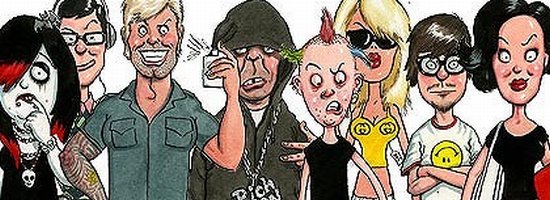
                    Perhaps the most interesting part of Raby’s study, which unfortunately she did not spend much time on, was the ways in which the teens she studied not only accepted but actively engaged with  the dominant idea of what a “teenager” is. Raby noted that “the teens that I interviewed had such difficulty negotiating their occupation and rejection of the category ‘teenager’…All of them easily cited negative stereotypes about teens…Often the young women would cite several negative stereotypes about teenagers, then distance themselves and their friends, often through the separation of ‘good’ teens from the ‘bad’ ones” (441). I find this particularly interesting because this seems to be a common practice in many subjugated groups (as Raby calls teens. Whether or not they can truly be considered a subjugated group is up for debate). It isn’t uncommon to have conflicted People of Color distance themselves from other POC, noting that they aren’t like “those other ____ folk” or people from lower classes using others as an example of what they are not/will never be (see half of the conversation surrounding Honey Boo Boo) These teenagers are both accepting and rejecting the dominant idea of what a “teenager” is. They view themselves as exceptions to the stereotype instead of really reflecting on the fact that perhaps the stereotypes themselves are flawed. I will use a PSA I found on Youtube to close this post. 

    It was made by a youth coalition, which is important to note. Because it was made by a youth coalition it seems like it would not be a ridiculous to assume that the teens had a lot of input on the direction of the video. Now, with that in mind, take a close look at the teen who wants beer. She is at once othered by her piercings and desire to drink beer and yet also very much “in line” because of those desires. The other teenagers are exceptions to the dominant stereotypes, look how clean cut they are! And they love root-beer ‘cause beer is totally uncool. It is interesting that these youth chose to make the “bad apple” a girl with obvious physical forms of “self-expression” and “rebellion” (the piercings). It’s clear that in this moment the youth coalition bought into the dominant discourses of what a rebellious teenager is/looks like/desires. 

    Questions and Comments:
    During the week I would like to discuss ways in which our mainstream media, particularly television shows and films aimed at teenagers, works to naturalize the discourses that Raby identifies. We should keep in mind that many of these shows 'about teen lives' are created by adults. Keeping that in mind will certainly lead to interesting analyses of popular representations of teenagers in media today.

    Works Cited

    Header image found here
    Discourse image found here

    Raby, Rebecca C. "A Tangle of Discourses: Girls Negotiating Adolescence." Journal of Youth Studies 5.4 (2002): 425-48. Web.

    Saturday, February 2, 2013

    Unlearning the Myths That Bind Us-Reflection


                    In “Unlearning the Myths That Bind Us” (from Rethinking Our Classrooms) Linda Christensen discusses the ways in which children’s stories, be they in the form of cartoons; fairy-tales; or films; work to, somewhat insidiously, pass on society’s dominant ideologies. She also describes the way in which her classes have dealt with the idea of children’s stories as a way to teach children how to behave in-line with societal expectations. There was nothing surprising in this reading for me, as I’ve been pretty aware of the ways in which our media, whether directed at adults or children, works to try and create conformists of us all. However, it was refreshing to read the ways in which Christensen’s students attempted to take direct action against this “secret education” (126).

                    One of Christensen’s students noted that “when we read children’s books, we aren’t just reading cute little stories; we are discovering the tools with which a young society is manipulated” (126). Omar hits the nail right on the head; taking a critical eye to stories and media aimed at children can prove to be very enlightening (and disheartening). Take, for example, one of the morals that Perrault offers for the classic fairy tale Little Red Ridinghood (the story, as well as the entire Norton collection of The Classic Fairy Tales can be found here):
                                    From this story one learns that children,
    Especially young girls,
    pretty, well-bred, and genteel,
    Are wrong to listen to just anyone,
    And it’s not at all strange,
    If a wolf ends up eating them.
    I say a wolf, but not all wolves
    Are exactly the same.
    Some are perfectly charming,
    Not Loud, brutal, or angry,
    But tame, pleasant, and gentle,
    Following young ladies,
    Right into their homes, into their chambers,
    But watch out if you haven’t learned that tame wolves
    Are the most dangerous of all.

    Perrault’s version of Little Red Riding is an incredibly common, and still told, version of the fairy-tale. This moral, a moral told to young children at the tail-end of a story meant to soothe them to sleep, not only perpetuates the idea that women must constantly be ever vigilant of men lest they get ‘eaten’ (also known as raped. Or, perhaps, even simply sexed before marriage) but it also highlights one of the (many) ways in which patriarchy is harmful to men as well as women. It depicts all men as being beholden to their carnal nature; it makes it sound like men are unable to control themselves and that they are inherently animalistic so all women just need to beware. This is a harmful idea to disperse not only because it feeds directly into our modern rape culture but also because it’s an incredibly insulting (and untrue) portrayal of men. It makes it seem as if all men are potential rapists (wolves) because they just cannot help themselves.  Now Little Red doesn't seem all that much like a “cute little story” does it? And it didn't even take the most critical eye to see the problem with this moral, it just took a mind open to questioning things that we've been taught to be comfortable with.

                    Christensen spends some time addressing stereotypes, their prevalence in children’s stories, and the ways in which they are harmful. She states that “the stereotypes and worldview embedded in the stories become accepted knowledge” (127). This idea, coupled with her earlier quote from Beverly Tatum (“cartoon images…were cited by the children…as their number one source of information”) is particularly troubling when we take a look at many of the cartoons that our society’s children are watching. There’s no getting away from the racism and sexism that is prevalent in children’s media. Jafar, from Aladdin, a somewhat recent Disney film, is portrayed as far darker and more “ethnic” looking than the ‘good’ characters from the film. Whether or not that is a coincidence (which is doubtful), the message it sends is that ethnic=bad (as well as ugly and old=bad, which we also get from Ursula in The Little Mermaid, the crone from Snow White, the list could go on). 

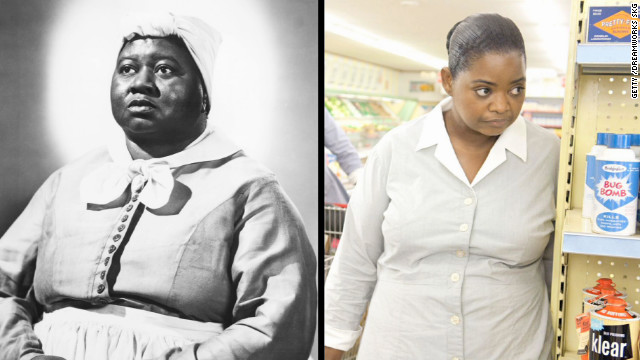
                    The stereotypes don’t stop once the images are no longer being targeted at children. Media is constantly pushing the dominant ideology on its consumers, whether the consumer is 3 or 33. This serves to ensure that the values that have been subliminally taken in stick with us. We have to be constantly bombarded with these problematic images otherwise we are more likely to hit that pane of glass in the river (for those that missed class on Thursday  this reference may be indiscernible, shoot me a message and I’ll clarify for you!).  Let’s use the past Black female Academy Award winners for example. All of these women were in films for adults. And they all portrayed common stereotypes of Black women.  Halle Berry, the only Black woman to have won an Oscar, won for Monster’s Ball in 2001 for playing Leticia Musgrove, a character that very much fits the common Black trope of the “Jezebel”. Five Black women have won Academy Awards for supporting roles. The first was Hattie McDaniel for playing the quintessential Mammy (known as…Mammy) in Gone with the Wind. Whoopi Goldberg won her Oscar for playing a Magical Nigress in Ghost. Jennifer Hudson was the overweight Black Diva in Dreamgirls (arguably the least offensive trope to have won an Oscar). Mo’Nique won her Oscar for her portrayal of Mary Lee Johnston in Precious; Mary Lee was an abusive, “welfare queen” who was a parasite not just on the system but also her daughter. And lastly to bookend the list we have the most recent Black Academy Award winner: Octavia Spencer for her role as Mammy Minny Jackson in The Help. All of these films are for adults. All of these films continue the “secret education” that we received as youths. The secret education starts early and it never stops, this is why we must be always be critical consumers. 

                   In class next week  (or perhaps in the comment section of this post) I would like to find out what stories/shows/movies my peers once loved (or still love) that, upon critical analysis, they see as being incredibly problematic and simply stories that are acting as mediums for the dominant society’s message. Me first: I love Mulan, but unfortunately there is plenty of sexism and problematic racial portrayals in that film. I still will break out in song anytime someone says "Let's get down to business", but I no longer love that film unquestioningly. Furthermore, I’d like to talk about ways in which people feel like we can take direct action and work to counteract the messages that are being forced down our children’s throats. Christensen’s class did some interesting work, I’d like to see how we can further build upon what we've read in the text. 


    Works Cited

    Christensen, Linda. "Unlearning the Myths That Bind Us." Rethinking Our Classrooms: Teaching for
    Equity and Justice / [editors ... Bill Bigelow ... Et Al.]. By Bill Bigelow, Linda Christensen, and Stan Karp. Milwaukee, WI: Rethinking Schools, 2007. 126-37. Print.

    McDaniel/Spencer Image found on CNN

    Sunday, January 27, 2013

    Media and Ideology: Reflection


                Croteau’s “Media and Ideology” was such a fitting piece for me to read at this point in my life. The work that I do with PARC, as well as the topics that I enjoy reading about, tend to have a foundation in criticizing the ideology of the dominant society. Croteau notes that “when scholars examine media products to uncover their ‘ideology’, they are interested in the underlying images of society they provide. In this context, an ideology is basically a system of meaning that helps to define and explain the world and that makes value judgments about that world” (159). I personally believe that the ideology of the dominant society is one that is patriarchal, White supremacist, and anti-Black. This ideology is often conveyed in various forms of media, although somewhat subtle to the unquestioning eye. To have the media act as a medium for the dominant ideology, given the prominence of media in our everyday life, is an incredibly powerful way to indoctrinate people. More often than not the media that we consume isn't obviously misogynistic or racist, instead the things being presented often seem “natural” or “normal”. Croteau touches upon this wonderfully in his section ‘Ideology as Normalization’. He states:
    Media texts can be seen as key sites where basic social norms are articulated. The media gives us pictures of social interaction and social institutions that, by their sheer repetition on a daily basis, can play important roles in shaping broad social definitions…the accumulation of media images suggests what is ‘normal’ (163).
    When we are constantly being faced with certain behaviors we begin to see them as “natural”. When in reality what has happened is that those behaviors have become naturalized in our minds because of how regularly we see these behaviors. This can be particularly harmful when we do not have many interactions with the communities whom we are watching or reading about. This was the thinking behind much of the protest about the Oxygen reality show All My Babies Mama’s (read more about the controversy here). Black folk in television are often presented as pimps, hos, minstrels, thugs, unstable, and various incarnations of the aforementioned tropes as well as others. When not looking critically it’d be easy for people to not realize the proliferation of those tropes and to not realize the ways in which they have begun to see every-day Black folk in similar ways, even subconsciously. This is the reason why when a ‘well-spoken’ Black person speaks they often get showered with compliments of how “articulate” and “eloquent” they are. Those delivering the compliments do not realize exactly where their surprise is coming from and instead thinks they are being complimentary when in reality they are behaving in a manner that shows a subscription to the dominant view of Black folks being under-educated and inherently inarticulate. At this point I’ve only focused on the way this type of representation of Black folk affect those outside of the Black community. To try and touch upon the ways it affects Blacks, particularly Black youth, would double the length of this post. To put it simply, the ways in which Blacks are often represented in media lends a direct hand in the internalization of racist and anti-Black beliefs within the Black community itself. This, however, is not a call for all representations of the Black community in media to be "positive", but rather a call for balance. As Langston Hughes said in "The Negro Artist and the Racial Mountain" we, as Black folk, "know we are beautiful, and ugly too". Instead of representing the reality of the multifarious nature of the Black community the media tends to simply represent the image of the Black community that falls in line with society's dominant ideology. 

    Another way in which we can see how the dominant society’s ideology is being dispersed through media would be to look at the treatment of Django Unchained. The film is being heralded as a great film about slave resistance when in reality it is simply a revenge film that takes place during slave times. A truly great film about slave resistance would be Haile Gerima’s Sankofa (which can be found in its entirety, although not the best quality, on Youtube). Our society has a focus on the individual, which is why a film where an individual takes out entire plantations can be beloved by all even when it does not truly represent what most resistance mobilizations look like. Sankofa, on the other hand, truly shows the collective nature of resistance and revolution. However, that theme (as well as many others), goes against the dominant ideology and therefore that film gets far less attention than the inferior Django UnChained.
    The viewpoints I have expressed in this post can be seen as controversial to some but that is because they directly counter many dominant themes of our society, particularly the false notion that we are passed conversations about race because we are ‘color-blind’ or have ‘evolved’. Because of this dominant theme those who do decide to have conversations that counter the dominant ideology are accused of being purposefully controversial or playing the ‘race-card’ (which is an offensive accusation that highlights the fact that we have not yet ‘evolved’). Similar sentiments are had when people try to expose the ‘subtle’ misogyny in pop culture. Let us not fall for “common sense” and rather continue to operate with a critical eye, for if we do not look at everything critically then we may easily succumb to an ideology that seeks to repress us. This is one of the points I hope we touch upon in class: the importance of analyzing and questioning everything (see Croteau page 166).
    Works Cited
    Croteau, David, and William Hoynes. "Media and Ideology." Media Society: Industries, Images, and Audiences. Thousand Oaks, CA: Pine Forge, 2003. 159-68. Print.


    Hughes, Langston. ""The Negro Artist and the Racial Mountain" (1926)." "The Negro Artist and the Racial Mountain" (1926). Web. 27 Jan. 2013.