Monday, April 1, 2013

Talking Points 8--Kimmel & Mahler: Adolescent Masculinity, Homophobia, and Violence (Argument)

In "Adolescent Masculinity, Homophobia, and Violence: Random School Shootings, 1982-2001" Michael Kimmel and Matthew Mahler argue that masculinity, and feelings of inferiority as it pertains to masculinity, may be the major contributing factor to acts of mass violence, particularly in schools. They argue that masculinity, more specifically White masculinity, may be intrinsically* linked with acts of violence. Throughout the article Kimmel and Mahler note how homophobia is often fueling the ways in which boys tease other boys as a way to call their masculinity in to question. The authors also address ways in which young men can resist certain factors that might crack others and cause them to turn to violent means as payback.

Above I note that the authors argue that White masculinity may be intrinsically linked to violence. That is my perception of their argument and the article, not necessarily something that they explicitly stated. In fact, one could argue that they believe the opposite to be true, that violence in not inherent in White masculinity. On page 1440 they conclude their introduction stating that "in [their] view, these boys are not psychopatholoical deviants but rather overconformists to a particular normative construction of masculinity, a construction that defines violence as a legitimate response to a perceived humiliation". This particular line can be read in a variety of ways, but I choose to read it as I've expressed above. The issue I have with this statement of theirs is the same issue that I have with a few other points found in this article: they don't go far enough. I don't think they level a harsh enough critique. These boys, these shooters, aren't overconformists. They are simply conformists who needed to prove that they were in fact still "men" and chose the grandest ways of doing so according to the doctrine of masculinity that they abide by. It is because of this fact that I feel comfortable stating that White masculinity is intrinsically violent, for it is not the same as me saying that men  are intrinsically violent but rather that the idea of what it is to be a man in our society has its foundation on violence and domination, particularly as it pertains to the White patriarch.

The other aspect of this article where I feel they do not go far enough or explore deep enough is their usage of homophobia. I don't disagree with their argument that homophobia plays a large role in the ways in which men have their masculinity put into question. I would argue, however, that as it pertains to the situations in this article it would have been better if they acknowledged that this particular form of homophobia has its roots in patriarchy and have very little to do with actual hatred and fear of the gay community. They come so very close but they drop the ball several times. For example, when they snarkily quoted Eminem and his idea of the word "faggot", they should have followed that quotation with a deeper exploration of the fact that this homophobic slur has little to do with being "Gay" and everything to do with being an inferior man. For the homophobia that many of these bullied boys face has very little to do with a hatred and fear of gay men, as stated above, and a lot to do with a hatred and intense fear of being an imperfect/failed man. And, if we go back to the 13th century church, women are imperfect men (Albert Magnus: Woman is an imperfect man and possesses, compared to him, a defective and deficient nature). There exists, possibly particularly amongst adolescent men but I doubt it is confined to that age group, a deep fear in many men of being "woman-like". The concept of masculinity that men in our society have been socialized to believe is one that has its foundation in hating women at the core. It is thought, mostly subconsciously, that to be a woman (when we're talking simply of patriarchy and not involving other factors such as race. If we were to explore race here then this concept would become far more complex) is the worst thing to be. In C.J. Pascoes' "'Dude, Youre a Fag': Adolescent Masculinity and the Fag Discourse" Pascoe states that "the relationship between adolescent masculinity and sexuality is embedded in the specter of the faggot. Faggots represent a penetrated masculinity in which 'to be penetrated is to abdicate power'...Penetrated men symbolize a masculinity devoid of power, which, in its contradiction, threatens both psychic and social chaos. It is precisely this specter of penetrated masculinity that functions as a regulatory mechanism of gender for contemporary American adolescent boys". She goes on to argue that "'Homophobia' is too facile a term with which to describe the deployment of "fag" as an epithet. By calling the use of the word "fag" homopobia--and letting the argument stop with that point--...obscures the gendered nature of the sexualized insults" (124).

This is not to say that "fag" or other forms of homophobic taunts and behavior are never just that, homophobic. But, in these instances, so often these slurs have very little to do with the sexual identity of the boys that are at the receiving end and everything to do with throwing that boy's masculinity into question. As Pascoe found in her research, and the quote that Kimmel and Mahler used of Eminem's supports, to be gay does not necessarily throw an individual's manhood into crisis (or, rather, does not necessarily throw an individual's manhood into crisis in the eyes of others. For that's what this is all about in the end, the perception of one's masculinity. These boys have to constantly prove their manhood to others, very little is actually about the way one feels about themselves). Pascoe states that "according to this group of boys, gay is a legitimate, if marginalized  social identity. If a man is gay, there may be a chance he could be considered masculine by other men". But, to be gay or "a fag" in the pejorative way used by these young men, does not mean to sleep with other men but rather to be a failed man.

I think that Kimmel and Mahler's article could only have benefited form a deeper exploration of the complexities of the "homophobia" that they cite as a factor in violent White masculinity. Although I think that this exploration would only have strengthened their argument, I also appreciate the strength and content of this piece as well as their section regarding resistance and acts of resilience. And I do acknowledge that I am  doing a disservice to anyone reading this by not fully exploring my own usage of "White masculinity" instead of simply "Masculinity". Part of my reasoning in doing this is because Kimmel and Mahler themselves are concerned with White masculinity, not masculinity across racial axes and so to simply use "masculinity" without the qualifier would be to skew and misrepresent their argument.

Questions for the class:
Did you find yourself disagreeing with points brought up in this article? Was it difficult for you to read this analysis of masculinity and keep your mind on the macro level or did you find that there were moments where you said to yourself "Well, my guy friends are nothing like this, so maybe there's not that much validity here?". I'm always interested to see the ways in which conversations/readings that are about structural issues end up getting derailed by a focus on the individual, and it's interesting to see the ways in which people struggle to maintain a macro-lens. It's a constant struggle, particularly when studying structural inequalities, but it is something that we would all do best to remember, that individuals may seem to be exceptional but they do not invalidate arguments about systematic/structural problems.


Monday, March 25, 2013

Talking Points 7: Brave, Orenstein--Connections

After reading Orenstein's chapters, particularly the section on "Pinkification" and then reading Tyne's blog regarding the Steubenville rape case, it only made sense that this performance came to mind. I'm glad I was able to find it as for a moment the poet's name escaped me but luckily I had posted it to tumblr a year or so ago and it was easy to find (that's why tagging is important, y'all!)
I'll post the text of it at the end of this post. Do watch the video, it's powerful

EDIT: For whatever reason the video isn't playing from here. Go watch it on youtube
Anywho, onto the post.


                Reading the Peggy Orenstein excerpts from Cinderella Ate My Daughter served not only to be a good supplement to the Pixar film Brave but also to our course assumptions, particularly the second (Youth is a Culturally Constructed Category). In the chapter “Pinked!” Orenstein gives many examples of how youth, and various stages of youth, are truly just cultural constructs and nothing more. Not only are these categories cultural constructs but they have been constructed to uphold our society’s dominant ideology of Capitalism. As Raby noted in “A Tangle of Discourses: Girls Negotiating Adolescence”, pleasurable consumption is a dominant discourse of teenagehood:
Youth today are courted as a high-consumer group, and are modelled in the
media as the ideal age, with teenagehood constituting the onset of ‘the best years
of your life’. Social historians often connect the emergence of adolescence to
processes of production and patterns of consumption (Raby, 437).
What Orenstein’s text makes clear is that teenagers aren’t the only valuable group that marketers target. The whole Princess line was created because of its marketability. Dora the Explorer, supposedly an example of Nickolodean’s subversive gender portrayals, might as well be a part of the Disney Princess line when it comes to her toys and other merchandise (Orenstein, 42). What’s actually good for the children, in this case the young girls’, psyche isn’t even a factor passed the first stage of product development. More important than teaching girls that they can be a wide variety of things, that they can embody a multitude of characteristics and interests, is cash-money. How does that not disgust everyone?

Another truly sad thing about many popular girls’ toys, particularly the Disney Princess line, is that these toys put docility and fragility on pedestal. It’s not as if these Disney Princesses are giving us subversive takes on what a princess is. They are very much in line with what we would expect. The Princesses that are showcased are always waiting for “True Love’s Kiss”, they love their man with every fiber of their being and would sacrifice themselves for said man, they often enjoy cleaning or are at least very good at it. They rarely have much motivation beyond love, and even if they started out with others motivations half way through their story LOVE becomes the biggest thing on their mind. There’s nothing wrong with love and wanting to be in a happy and fulfilling relationship, but to teach our young girls that that’s what their main focus to be is a great detriment. Even the princesses who we think combat the dominant depiction of the servile and fragile princess actually aren’t subversive at all.. In Croteau’s “Media and Ideology” he notes:
Research on the ideology of media has included a debate between those who argue that media promote the worldview of the powerful—the “dominant ideology”—and those who argue that mass media texts include more contradictory messages, both expressing the “dominant ideology” and at least partially challenging worldviews (Croteau, 161)

Where Croteau doesn’t go far enough, in this particular piece, is that he does not address how the seemingly contradictory messages are often just disguises, Trojan horses if you will. Take Mulan for example. I wrote about this before in a comment section to Julie’s second blog post on Christensen’s “Unlearning the Myths that Bind Us”. Mulan is NOT the gender-bending badass “Princess” that people like to believe she is. Nala, from Lion Kind, is more badass than Mulan to be honest. Mulan is a strong woman, yes, but the strength that she exhibits is simply a different expression of the same beliefs as the other princesses. Mulan’s great sacrifice, risking her life to fight, was in order to protect her father. It was an act of selflessness, which is a characteristic that we often teach to our young girls. Selflessness, self-sacrifice, these are traits that we instill, usually covertly, to the young women in society. In moderation these traits aren’t terrible, and in fact can serve to make someone a compassionate human being. However, girls aren’t often taught to be self-sacrificial in moderation. We are taught that we need to serve others, that we must be kind and caring and help others in any way that we can (even if that serves to hurt us). That’s a damaging thing to constantly be teaching kids, especially if no counter-message is produced.

Orenstein touched upon a wonderful point when she mentioned the ways in which intragender competition is taught to girls. There can only be one highlander princess. That princess must be the fairest in the land or else she risks her status as a princess. This competition is not only with the girls’ peers, it’s intragender-intergenerational competition that is bred. We see this through the common tropes of women presented in these stories: The Crone, The Matron, and the young beautiful girl/princess. The Crone is what we never want to be, the Crone is the old Queen who gave Snow White the apple. The Matron…well she has one foot in the doorway to Croneville. The Princess…she’s the one we want to be, she’s good/nice/sweet/beautiful/etc. This is another message that’s often given covertly (through a “secret Education” if you will). As I said, take Snow White for example. We all know what trope Snow is. The Queen, however, inhabits both. She is at once the Matron and the Crone. As she ages, she becomes more evil and more overtaken by jealousy. At the peak of her despicability she is THE CRONE. Older women are rarely depicted as anything other than evil in Princess tales (unless their ~*~*magical fairies/godmothers*~*~). We even get this in Brave, the so-called feminist Princess movie. There’s really no evil antagonist in Brave. The closest that we come to evil would be the Witch *cough*Crone*cough*. She set everything awry in Merida’s life, and if she could do that who knows what evil she’s capable of.
I did enjoy Brave, it was an entertaining film to watch. However, it was not a feminist Princess flick in the least. The majority of the competition in the film was intragender, as usual. The most subversive part of the film wasn’t that Merida was athletic and could shoot arrows like nobodies’ business but rather that she was a selfish brat. I’m not saying this because she wanted to put herself first over tradition, but the lengths that she went were incredibly selfish. Enlisting in some random witch’s help to change one’s mother is generally not a good idea. As they say in Once Upon a Time “magic always comes with a price”. And it did. Even after her mother was turned into a bear it took forever for Merida to stop thinking solely of herself and to see her mother’s plight (that she caused, mind you). And so we're still left with basically what we had before Brave. We lack a good example of a balanced character for young girls. Merida's selfishness makes me question her strength. Is she truly strong or is she just self-centered? We don't want to teach children to only be selfless, but we also don't want to teach them that they should ONLY think about themselves (unless they turn someone into a bear, then they should probably get some compassion and get their shit together).

Anywho, I don’t want to linger too long on Brave or else I won’t have anything to say in class tomorrow.

Speaking of class, I suppose my questions would be: How did y’all see Merida? Did you see her as a feminist Princess? Do you think she’s a good role model for girls? What would you envision a “feminist princess story” looking like? What would the characteristics of the Princess be? Is it possible to have a feminist princess story?


And now the text of the poem, as promised


PAPER DOLLS
Sierra DeMulder

We are taught
from the moment we leave our pink nursery
that we are collapsable paper dolls
light to hold
easier to crumple. 
that as women our worth lives secretly wrapped in lace and cotton panties
our fragility armored with pepper spray and mace, they say:
ONE IN TEN. ONE IN SIX. ONE IN THREE
women will be raped or sexually abused in their lifetime
and I am one of three daughters.

Now imagine: each victim is an acrobat
Her sanity, a balancing act
Our response is the unfailing safety net
We never expect to see her across the wire
You weren’t just violated, we tell her
You are an empty museum
A gutted monument to what used to hold so much worth
And with the best intentions we tell her to reclaim it,
Put a price tag on her rape and own it,
But don’t stand too tall, don’t act too strong
or we will name you denial, come back when you’re ready to crumble
Like your bones are made of chalk
You may only laugh cutely or cry beautifully
So cry beautifully
We will catch you

We are calling it theft 
As if he could pluck open your ribs like cello strings
Pocket your breasts, steal what makes your heart flutter and tack its wings to his wall,
Some days you will feel dirty!
Some weeks you’ll remember how hard it is to breathe in public, like your heart beat is climbing to the attic of your throat only to suicide itself out on the pavement
But know this: the person who did this to you is broken, not you.
The person who did this to you is out there, somewhere choking on the glass of his chest, 
it is a windshield, and his heartbeat is a baseball bat saying regret this, regret this

NOTHING WAS STOLEN FROM YOU.
Your body is not a hand-me-down
There is nothing that sits inside you holding your worth,
no locket that can be seen or touched, sucked from your stomach and left on the concrete
And I know it’s hard to feel perfect
when you can’t tell an Adam’s apple from a fist
because some ashtray of a man picked you to play his Eden.
but I will not
watch you
collapse.

    Saturday, March 16, 2013

    Final

    Some ideas for the final
    I was thinking of perhaps finding a way to explore the intersection of race, specifically Blackness, with the discourse of teenagers. Certainly there are ways I would be able to make an argument that at the intersection  some of the discourses/ideas about teenagers are multiplied exponentially (off the top of my head the "wilding" from the conversation surrounding the Central Park 5 and the discourse of social problem). I don't know what I'd use for the media text itself but I suspect it wouldn't be terribly difficult to find one that would allow me to draw on the texts from class as well as a few others. For this topic I would certainly utilize the "Report on the Extrajudicial Killings of 110 Black People" from Malcolm X Grass Movement, primarily to supplement my usage of Jackie Wang's article "Against Innocence: Race, Gender, and the Politics of Safety". Potentially the week that we discuss "Hip Hop Controversies" would unearth some great material for me to use as well. I could also probably get some inspiration from Byron Hurt's Hip Hop:Beyond Beats and Rhymes depending on the Tricia Rose texts that we use.

    A couple of weeks ago I finally broke down and watched Pretty Little Liars after MANY people suggested I watched it (surprisingly, the average age of the people suggesting it? Mid-late twenties. Perhaps no the target audience but they are definitely lapping it up!). I finished the two seasons in a couple of weeks, and have had to use all of the will power within me to not start the third season. This show revolves around teenagers (although if some of the scenes didn't occur in a high school you'd probably think they were college students) and definitely plays on the discourses put forth by Raby. It'd be easy to incorporate "Media and Ideology" with this text as well (the capitalism/conflict theory portion especially. And pleasurable consumption from Raby. One of the character's LOVES to shop [steal..], they're all generally rich, and have amazing wardrobes).

    Sunday, March 3, 2013

    Midterm

    For the midterm I've chosen to kind of merge prompt 2 and prompt 4 (the "do what you want" prompt). The reason I don't feel comfortable simply saying that I'm choosing prompt 2 is because I intend to put the authors of our past readings into conversation with more than just each other.

    The past few days have been really hectic with work (work-work...as in paid work) so I've unfortunately not been able to flesh this out as fully as I would've liked to by now. This doesn't worry me as I have no doubt I will get everything done by tomorrow evening (after work. WAHH, why do I need money?!?! Someone should pay me to be a student. Oh, how I can only hope to find a grad program that will put money in MY pocket).

    I had a moment of stress yesterday evening because I felt so lost. I have no trouble with the readings, but to try and figure out what to do for this project? That really had my head spinning for a little bit. But, things are calm now and I've figured out exactly what I'm planning to do. All of you (my educators, meaning my peers as well as Dr. Bogad and Chris) have inspired this project.

    As to what program I will utilize....I'm torn between voice-thread and prezi. So, I'll probably make both to see which one I like better.
    OOOH!
    At the end of that sentence "....I like better." a great thought came to my mind. Okay, as of this moment, this very moment, there is a high chance I will use Weebly.

    Wow, I just got so much more excited about this project! And excitement is the best motivator. Woohoo!

    Oh, okay, before I end this I suppose I should give a little bit more information. Because I'm the most fascinated by (and comfortable with, probably due to my interest) the Croteau and Wesch pieces I will primarily use those two, but as I like to get as many points as I can I will more than likely try to work in all of the past readings (if that's not feasible then I will at least work in Christensen, particularly because her prescriptive section ties in nicely with Wesch)

    Hopefully this outlined enough information without giving it all away. Mystery is part of the allure, after all.

    Thursday, February 28, 2013

    Happy birthday to MEEEEEE

    Little toddler me!
    NOW 22, WHOOP WHOOP. Another year! Still, unfortunately have a vertical license. It doesn't expire until 2016. I can't wait to get my nice horizontal grown-up license.

    Sunday, February 24, 2013

    Michael Wesch-From Knowledgable to Knowledge-able---Reflection


    The quality of light by which we scrutinize our lives has direct bearing upon the product which we live, and upon the changes which we hope to bring about through those lives. It is within this light that we form those ideas by which we pursue our magic and make it realized. This is poetry as illumination, for it is through poetry that we give name to those ideas which are, until the poem, nameless and formless-about to be birthed, but already felt. That distillation of experience from which true poetry springs births thought as dream births concept, as feeling births idea, as knowledge births (precedes) understanding.

    As we learn to bear the intimacy of scrutiny, and to flourish within it, as we learn to use the products of that scrutiny for power within our living, those fears which rule our lives and form our silences begin to lose their control over us.-Audre Lorde, “Poetry is Not a Luxury”

    I’ve chosen to begin with this particular epigraph, an excerpt from Audre Lorde’s “Poetry is Not a Luxury” because I feel it details, in a wondrously poetic fashion, some of the framework that I will be working from and the perspective I am critiquing the Wesch text through. Hopefully as you read this post you will more clearly understand why I’ve chosen this particular Lorde excerpt, but if anything is unclear in my choice of quotes or anything I bring up throughout this post then please feel free to ask for clarification and shoot me questions in the comment section.

    Michael Wesch
                In “From Knowledgeable to Knowledge-able: Learning in New Media Environments” Michael Wesch discusses the ways in which the predominant current teaching methods are no longer apropos given the new technological age that we are currently living in. He posits that the current teaching methods, and the classrooms themselves, are:
    built to re-enforce the top-down authoritative knowledge of the teacher…the ‘message’ of this environment is that to learn is to acquire information, that information is scarce and hard to find (that’s why you have to come to this room to get it), that you should trust authority for good information, and that good information is beyond discussion. In short, it tells students to trust authority and follow along (1).

    He goes on to note that the new digital age has given people the ability to access knowledge in a new way. In this new way of accessing knowledge they are not simply taking in information that an authority figure is spewing at them but rather they are directly engaging with the information; they are aiding in its creation, its delivery, and everything in between. He argues that knowledge, as it stands now, is not something that can simply be fed to an individual, it is something that must constantly be interacted with and in order to keep up with the way that the digital age has allowed students to engage with information classrooms and teachers must change up their stale authoritarian routine and find ways to “move [their students] from being simply knowledgeable to being knowledge-able” (1). This means that they need to learn how to truly engage with the material, they must be able to critically look at texts and analyze them, not simply memorize ‘important’ facts and reiterate said facts when an exam comes along.
                Now, just because I am able to summarize his general argument (at least in the way that I read the text) does not mean that I completely agree with the points that he uses. There were a few moments when I had to disagree with his statements, and other moments where I felt he was simply not delving deep enough.
                Given that Wesch chooses to use the language of revolution, it is disappointing that he doesn’t really deliver a deeper analysis of some of the systems that he rails against and for. One of the dominant discourses of society is that of Individualism. As the State has gotten more powerful it has worked to eradicate a sense of community and collectivism amongst people (this is clearly an attempt to stifle resistance, for no resistance can occur if people cannot develop a collective consciousness). This idea of individualism and submissiveness (to the State and those who represent the state i.e: Authority) is taught to us in many ways and settings, and one of those settings is within the classroom. Wesch notes that the current teaching methods often rely on the educator being seen as the authority figure and that all of the students must follow the instructions of said authority figure very closely. Lecture style classrooms do not breed community, they breed submission and regurgitated thinking (regurgitated thinking: we spit back out the same thought/ideas/lessons that we take in. The delivery will more than likely be in a different order from the original thought digested but the content will be exactly the same). Wesch states that the “Web 2.0” breeds a “spirit of interactivity, participation, and collaboration” (1) and that new model classrooms and teaching styles should invoke the same spirit. Doing so fosters community; it fosters connections between students with their peers and their professor. It allows knowledge and information to seem more dynamic instead of static and stagnant. The current teaching methods simply reenact the same dominator/dominated; authority/submissive narrative. In order to have a social resistance, whether it is within the classroom or beyond it, we need to advance beyond the current methods into something that creates a new, more revolutionary, narrative.
                Throughout the reading I took issue with Wesch's assertion that within new media we are able to be “creators” of information, he states this first when he talks about bloggers crating information (2). I have to strongly disagree with that. We, as bloggers or writers, are not creating information. We are vessels for information. Blogging has simply given us a new way to share said information that we have within ourselves with others. Yes, perhaps we are providing this information in a new way, but I would be hesitant to say we are “creating” it. We are simply furthering the path of information. What we are creating…what we are producing…is thought. Thought based on the information that we have collected, but we are not creating information itself. We are compiling the information and turning it into something. On a similar note, I did not appreciate Wesch’s argument that “our old assumption that information is hard to find, is trumped by the realization that if we set up our hyper-network effectively, information can find us” (2). He then goes on to use an example of a web app that I have never heard of, which feeds into my opinion that his argument comes from a place of privilege. I could make the argument that within academia there is SO much information, it seems limitless and like it is constantly coming at me. However, to say that statement and that statement alone would be ignoring the fact that academic information is hard to find for some people. Web information, even with the ubiquity if the internet, can be hard to find. Some people do not know what to look for, where to explore, or what to explore. The question becomes: How do we share our knowledge with a wider audience? Simply putting it online is not enough. How do we cultivate the appropriate audience? What even is the appropriate audience? If we limit it to fellow academics like ourselves then are we simply moving the traditional classroom onto the internet? And if we choose to broaden our audience base how do we ensure that we get as many people as we can, and how do we guarantee that we are actively engaging with them?
                A bit later Wesch discusses the idea of the “crisis of significance”. He states that we need to “bring relevance back to education” (2). I would argue that we would first have to define what education is. And this is not only the job of the educator but also the job of the person being ‘educated’. Why do they want to be ‘educated’? What do they see ‘education’ as? What is the goal of their ‘education’? For me, education for liberation is my goal. Therefore, the types of knowledge that catch my attention are most of the things that I can find applicable to resistance, resistance mobilizations/theory, forms of resistance, and foundational to revolutionary action. This framework makes many concepts quite significant, even if it doesn't seem so at first. To use this class as an example, learning about media as a medium for ideology is critical for me, as I must be able to see all of the ways that the ruling/dominant class works to manipulate and further repress others. If I cannot see how they are working against us, how could I possible begin to address ways in which to dismantle the system/structure? I think that it is our duties as students, as active engagers with knowledge, to question what our guiding framework is and what our goal is. Are you simply learning in order to eventually get a career? If so, why is that? What has taught you that in order to be ‘complete’ you need to learn things that may mean nothing to you in order to be in a job that also may mean nothing to you in order to earn a paycheck? There’s not necessarily anything wrong with that, what’s wrong (or perhaps "problematic" would be a better word) is following a narrative that has been written for you without ever stopping to question what the narrative is and why you feel the need to follow it. We must all develop a working framework for how we seek and ingest knowledge/information.
                Because this post is plenty long enough I will attempt to wrap it up by addressing Wesch’s “Not Subjects but Subjectivities” section while incorporating another quote from the magnificent Audre Lorde. This is, perhaps, the section that I had the least complaints about (other than my overarching complaint that Wesch does not delve as deeply into some of these concepts as he could/should). Wesch states that “learning a new subjectivity [ways of approaching, understanding, and interacting with the world] is often painful…You have to unlearn perspectives that may have become central to your sense of self” (3). How could I note read this as “DECOLONIZE/LIBERATE YOUR MIND!”?? Our knowledge, our current subjectivity, is not our own. It is the dominant society’s knowledge/subjectivity. We are often taught frameworks that do not allow us to further analyze our surroundings, at least not in ways that would allow us to truly QUESTION, TRANSFORM, and RESIST. At the end of her poem But What Can You Teach My Daughter Lorde states that “even my daughter…knows/what you know/can hurt/but what you do/not know/can kill”. We need to teach that! This should be our working framework! If this were our framework then would we not all be interested in gathering as much knowledge as possible and engaging with it as much as we can? If we acknowledged the fact that the knowledge that we allow to slip through our fingers could prove fatal (be it literally or metaphorically in the sense of social or civic death), then we would try our hardest to take in as much as we could, and not only that, but we would try to understand it and work with it to the best of our abilities? And with the more knowledge that we take in, the more that we develop our working frameworks for life/knowledge-gathering, the more successful we will be at dismantling the system that works to oppress/repress/suppress us!

    To try and put my questions and comments into one section would be impossible! My questions for the class are strewn throughout this post. I suppose my biggest question(s) for the class would be: what is your guiding framework for knowledge-intake? What is your goal when it comes to education? How often do you question the goals that you have that seem to be natural to you?

    And, because I love this poem so darn much, I will end this post with it.

    But What Can You Teach My Daughter
    What do you mean
    no no no no
    you don’t have the right
    to know
    how often
    have we built each other
    as shelters
    against the cold
    and even my daughter knows
    what you know
    can hurt you
    she says her nos
    and it hurts
    she says
    when she talks of liberation
    she means freedom
    from that pain
    she knows
    what you know
    can hurt
    but what you do
    not know
    can kill.

    Works Cited

    Lorde, Audre. The Collected Poems of Audre Lorde. New York: Norton, 1997. Print.
    Lorde, Audre. "Poetry Is Not a Luxury." Power, Oppression and the Politics of Culture: A Lesbian/Feminist Perspective. Web. 24 Feb. 2013.
    Wesch, Michael. "From Knowledgable to Knowledge-able: Learning in New Media Environments." Academic Commons. Web. 24 Feb. 2013.

    First image found here
    Second image found here
    Third image found here

    Saturday, February 23, 2013

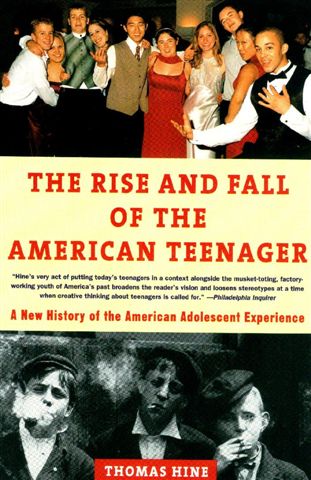
    Thomas Hines-The Rise and Fall of the American Teenager: Quotes/Reflection


    Because I have merged the format of Quotes and Reflection I have chosen to work with only two quotes so that I may explore them more in depth while still maintaining a reasonable word count.

    ’Maybe I’m something special, and maybe I’m not. Maybe I’m here for a reason and I might be going somewhere after this, but then again I might not. I wonder where I fit in?”…Figuring out where they fit in—to the universe, the world, the economy, their social circle, their family, is a project on which teenagers spend a lot of their time and energy…study after study suggests that teenagers’ principal preoccupation is to adapt, to find a place in life. (2)


    Thomas Hines, in his introduction to The Rise and Fall of the American Teenager, quotes his younger, seemingly angstier, self as a way to personally connect with the studies that he alludes to (these studies that talk about how teenagers are constantly on a quest to “find themselves”). He does so not to prove that these students are right but rather to highlight ways in which our teenage self isn’t a completely different entity from our grown-up self. This is the same idea that we address with our third course assumption: Teenagers are not some alien life form.
    On a personal level, the thoughts that Hines quotes from his younger self are thoughts that are constantly running through my mind. I am always wondering what the goal of my existence is, if I will become “something” if I will “be somebody”. The fact that these thoughts are constantly running through my head does not expose me to be stunted but rather it shows that I am human. I am a human who has grown up in this Western society. Let’s take a look at some of the “greatest” writers (I put “greatest” in quotes because there is always a question of how and why some authors are canonized and others are not, but that is not a relevant train of thought for this post) and philosophers: are not most, if not all, of them in some sort of perpetual existential crisis? Are these thoughts that Hines quotes not the thoughts that run/ran through their head constantly and served as major themes for their work? And yet somehow we have decided that it is only teenagers who are on a quest to find themselves when, in reality, we are all on the same quest. We live in an individualistic society, which not only means that we lack a sense of community with each other; it also means that we see ourselves as individual, independent, beings with personality and thoughts that mean something. Given that we identify ourselves as individuals first and community members second (or never) we, of course, are then always trying to figure out just who exactly we are. This is not a teenager crisis, it’s a human crisis.

    This lengthy waiting period has tended to reduce young people’s contacts with older people and increase them with people who are exactly the same age. That, in turn, has led to the rise of a youth subculture that has helped define and elaborate what it means to be a teenager (7).
    The lengthy waiting period Hines is talking about is the “long period of education, exploration, and deferred responsibility” (7). Teenagers are in school longer than their predecessors (or, rather, their predecessors’ predecessors); they are less likely to be expected to work, and generally when they do work they are employed at places that aim to hire teenagers; and they are expected to be on the aforementioned existential journey to find themselves. All of these factors lead to less cross-over with non-teenagers and so teens are often surrounded by their peers, resulting in "youth subculture".
                    Now, just because I can summarize Hines’ argument does not mean I agree with it fully. This point of his is perhaps the point that makes it the most obvious that his usage of teenager actually means middle-class White teenager. Depending on one’s social class and situation it should not be expected that they 1) will not be working and 2) will have less interaction with those older than themselves. This does not take in account the families who live in a household with multiple generations (and thus are not only spending time with people a bit older than themselves but with those who are FAR greater in age). A teenager who has to help support the family does not have the luxury to only choose a job that allows them to essentially shoot the breeze with other teens. They will be on the hunt for a job that best suits their needs and their schedules, regardless of the age and life circumstance of their co-workers. And having to be a pillar of support for the household tends to mean lots of work hours, and if this teen is a good student then they certainly do not have all that much time to spend hanging out with other teens. Free time is a luxury for many teenagers. I’m not saying that what Hines posits is wrong but rather that it just does not take enough different factors into account. He should have made a disclaimer or made a less generalizing claim, but because he did I feel that it is our duty to take him to task for that (even if it is simply on our blogs and in class). In general, in class I would like to further discuss the ways in which Hines makes it clear that the “teens” he talks are about are middle class White teens. Middle class White teenagers is a shrinking group, there is no reason why texts should still use them as a norm, and no reason why we should accept that norm willingly.

                    On a personal level, I have to wonder if some of these things are why I often feel a bit of a disconnect with my peers. I’ve been working since I was 13 and had 3 jobs at the age of 15. Due to various personal life circumstances I did not have the “typical” (again, what is “typical”, really?) teenage experience. This idea of the “teen subculture” is so prevalent that those who existed outside of said subculture are at a bit of a loss with their peers. That doesn’t make those of us who had different teenage experiences any less of a “teenager”, it simply means we didn’t have the expected teenage life. And in these changing times, how many people are actually having the expected teenage experience? What is the “teenage subculture” truly? Can we simply give it such a general name when the subculture may vary by race, region, etc? And, by implying that there is a shared “teenage experience” aren’t we furthering the feelings of confusion, angst, un-belonging, for those teenagers who exist outside of said experience?

     Works Cited
    Hine, Thomas. The Rise and Fall of the American Teenager. New York: Bard, 1999. Print.

    First Image found here
    Second Image found here
    Third Image found here